When a gas fireplace won’t light or won’t turn on, the cause is usually on a short list, and a few of them you can check yourself in five minutes. This gas fireplace troubleshooting guide walks through the most common symptoms, from a pilot light that won’t stay lit to a burner that won’t come on, what usually causes each one, and where the safe homeowner checks end and a gas fireplace repair call begins.
One rule before you start: if you smell gas, stop. Turn the fireplace off, leave the area, and call for help from outside. Nothing below is worth troubleshooting around a gas smell.
Know which kind of system you have
How you troubleshoot depends on how the fireplace lights. Check your owner’s manual or look at the controls behind the lower access panel.
- Standing pilot (millivolt). A small pilot flame burns all the time. You light it with a control knob and a push button igniter that clicks. Heat from the pilot generates the small voltage that runs the gas valve, so it works during a power outage.
- Electronic ignition. The pilot only lights when you turn the fireplace on, using a spark. These systems need household power or batteries in a backup pack, and most run from a remote or wall switch.
Many newer fireplaces and inserts can switch between a continuous pilot and an on-demand pilot, which is worth knowing as you go through the list below.
How to light the pilot light on a gas fireplace
On a standing pilot fireplace, relighting the pilot is a normal homeowner task. The exact steps are printed on the lighting label, usually on the back of the lower access panel or on a tag near the valve, and that label always comes first. Most follow this pattern:
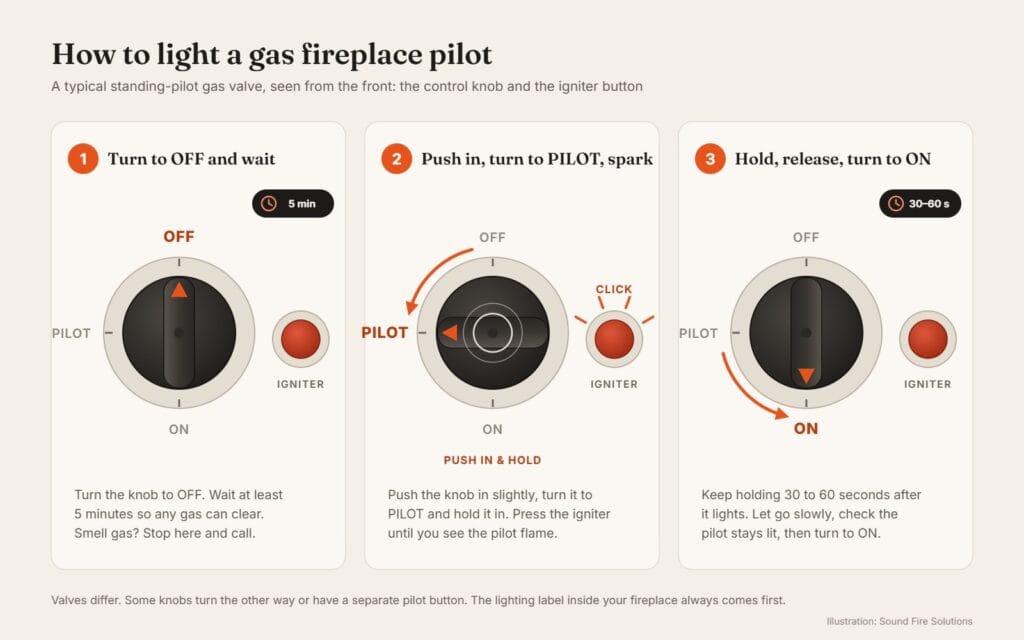
- Open the lower access panel and find the control knob, marked OFF, PILOT and ON.
- Turn the knob to OFF and wait at least five minutes so any gas in the firebox clears. If you smell gas, stop here.
- Turn the knob to PILOT and push it in. This sends gas to the pilot only.
- While holding the knob in, press the igniter button until you see the pilot flame. It can take several clicks, especially if the gas has been off.
- Keep holding the knob in for 30 to 60 seconds after the pilot lights, so the thermocouple heats up.
- Release the knob slowly, check that the pilot stays lit, then turn the knob to ON.
With electronic ignition there is no knob to hold. The pilot lights on its own when you turn the fireplace on with the switch or remote. If it will not, start with the checks below.
Gas fireplace won’t light
If nothing lights at all, not even the pilot, start here.
Check first:
- Is the gas shutoff valve for the fireplace open? The handle should line up with the pipe.
- Are your other gas appliances working? If not, the problem is upstream of the fireplace.
- On electronic ignition, are the batteries in the receiver or backup pack fresh? Is the unit plugged in and the breaker on?
- Are you following the lighting instructions on the label inside the access panel exactly, including holding the knob in long enough?
Usually caused by: air in the line after the gas was off for a long time, a clogged pilot orifice (spiders and insects love them), a cracked or misaligned igniter electrode, or a worn out push button igniter.
Pilot light won’t stay lit
If the pilot lights but goes out when you let go of the knob, or the pilot light keeps going out on its own, you are not alone. This is one of the most common calls we get. On a standing pilot system, the thermocouple is what tells the gas valve the pilot is lit. If it is worn, dirty, or not sitting squarely in the flame, the valve shuts the gas off the moment you release the knob. When cleaning does not fix it, a gas fireplace thermocouple replacement is a routine repair.
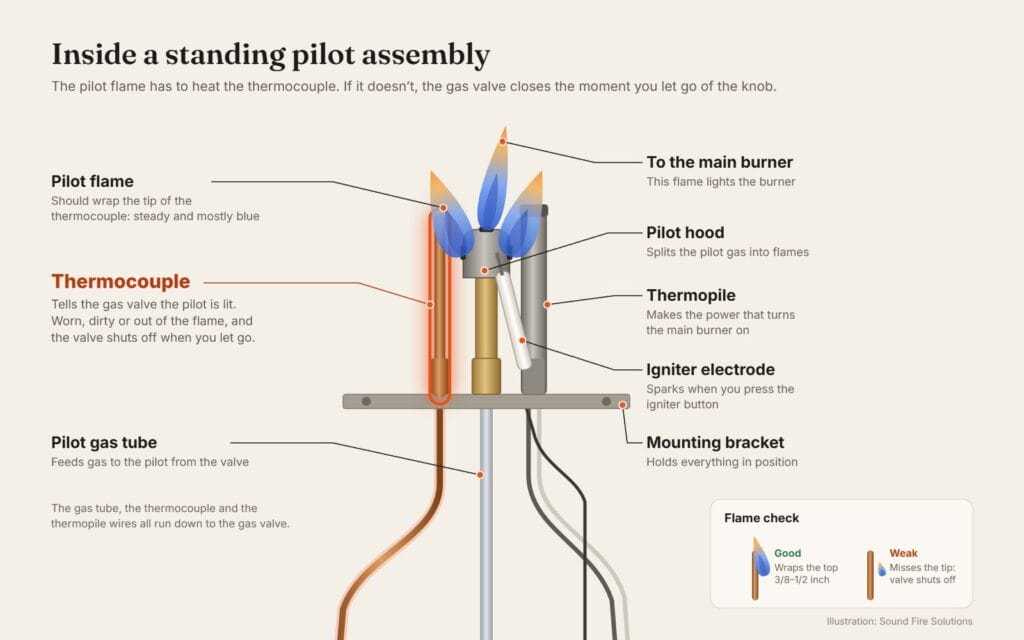
A small, weak, or wavering pilot flame usually points to a dirty pilot assembly. Either way, this is a cleaning or parts repair for a technician, not something to adjust yourself.
Gas fireplace not turning on (pilot is lit)
If the pilot is burning but the fireplace won’t turn on from the switch or remote, the problem is usually in the controls.
Check first:
- Batteries in the remote, and in the receiver if it has them
- That the control knob is set to ON, not PILOT
- That the wall switch or remote is on the right setting. If the gas fireplace remote is not working at all, check that it is still paired with the receiver. Most have a simple re-sync step in the manual.
Usually caused by: a thermopile that no longer produces enough voltage to open the valve, a bad wall switch or loose wire, or a failed receiver. A technician can measure the thermopile output in a couple of minutes and tell you which one it is.
Gas fireplace turns on, then shuts off
If the fire lights, then shuts off after a few minutes, this is the one to take most seriously. A weak thermopile or thermocouple can cause it, but so can:
- A venting problem, such as a blocked or disconnected vent, a nest in the vent cap outside, or exhaust being drawn back into the air intake
- A safety switch doing its job because it has detected overheating or exhaust spilling where it should not
Do not keep restarting a fireplace that shuts itself off. Have the venting and safety controls checked before you use it again.
Gas fireplace low flame
Check first:
- The flame height setting on the control knob, remote or wall control. Many are simply turned down to low.
- That the gas shutoff valve for the fireplace is fully open, not partly closed.
- That the logs or media have not slid over the burner.
Usually caused by: a dirty or partly blocked burner or orifice, or a gas pressure problem at the valve. Checking gas pressure and cleaning the burner are jobs for a technician.
Yellow, lazy, or sooty flames
Gas flames often have yellow tips by design, especially with log sets. What is not normal:
- Black soot on the glass, the logs, or the wall above the fireplace
- Flames that are tall, floppy, and dark orange, or that reach well past where they used to
- A noticeable change from how the flame looked last season
These usually mean the logs or media were moved and are blocking the flame, the burner or air intake is partly clogged, or the venting is not working correctly. Incomplete combustion produces carbon monoxide, so turn the unit off and have it serviced, and make sure your CO alarms are working in the meantime.
White or cloudy film on the glass
Some fogging when you first start the fireplace is normal condensation and clears as it warms up. A white haze that stays is residue baked onto the glass. Clean it only when the glass is completely cool, using a cleaner made for gas fireplace glass. Household glass cleaners can streak or damage the glass once it heats up. If the film comes back quickly, or the glass looks dark or black rather than white, have the unit checked.
A smell when you turn it on
- First fire of the season: a dusty, burnt smell for the first hour or so is usually dust burning off the burner and firebox. It is normal and fades.
- A brand new unit: paint and materials cure during the first several hours of use. Open a window and follow the break-in steps in the manual.
- Gas or rotten eggs: not normal. Shut it off and leave.
- An ongoing chemical or burning smell: something near the unit may be getting too hot, or there may be a venting issue. Stop using it and call.
Igniter clicking but not lighting
On electronic ignition, continuous clicking with no flame means the spark is not lighting the pilot, or the system is not sensing the pilot once it lights. On a standing pilot, a click with no spark at the pilot usually means a cracked electrode or a loose wire. Both are service calls.
The blower is loud or will not run
Most blowers switch on automatically once the unit heats up, so give it 10 to 15 minutes. If it never starts, check that the unit is plugged in and the blower control is turned on. A blower that rattles, squeals, or grinds usually has dust and pet hair built up on the fan, or worn bearings.
Still won’t light? When to call a professional
- Any smell of gas
- Soot, or a flame that looks noticeably different
- A fireplace that shuts itself off
- Cracked glass, or a door or glass panel that does not seal
- Anything that would mean removing the glass, logs, burner, or valve parts
Gas fireplace repair is a big part of what we do, on units we installed and plenty we did not. If your gas fireplace or insert is still not working, schedule a service call and we will track it down.